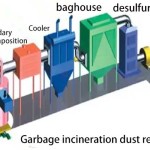
Sistema di raccolta polveri per incenerimento dei rifiuti

- Descrizione
- Inchiesta
INTRODUZIONE
For municipal waste incineration, not only is it necessary to remove soot, NOX, SOX, HCL, ecc. in the exhaust gas, but also a technology to reduce dioxins and heavy metals in the soot is also important. Inoltre, from the viewpoint of recent global environmental problems, particularly from the viewpoint of suppression of greenhouse gases, the heat generated at the time of garbage incineration is effectively utilized.
The gas discharged from the waste treatment and incineration facility contains components such as dust, NOX, SOX, HCL, CO and dioxins.
In order to reduce NOX, the two-stage combustion method (a method of adding a part of the combustion air to the middle of the furnace, controlling the oxidizing atmosphere and reducing the amount of NOX), and the exhaust gas recirculation method (mixing the gas with the combustion air to weaken the oxidation At the same time, the method of reducing the amount of NOX generated by the atmosphere, ecc.) controls the NOX generation technology and the denitration technology that adds the atmosphere to decompose and reduce NOX.
LARGE WASTE INCINERATION PLANT
Storage and feeding system: This system consists of a garbage storage pit, grab, crusher, feeding hopper and troubleshooting/monitoring equipment.
Incineration system: The equipment inside the incinerator
Waste heat recovery system: It includes boiler pipes (i.e. evaporators), superheaters, economizers, furnace tube soot blowing equipment, steam ducts, safety valves and other devices arranged around the combustion chamber.
Power generation system:
Feed water treatment system: It mainly treats tap water or groundwater sent from the outside
Waste gas treatment system: The waste gas generated from the furnace must be treated to the emission standards before being discharged.
Waste water treatment system:
Ash collection and treatment system:
Dust Collector Scegli